


Gates G-Force C12 Drive Belt
1004-3285 (MFG #: 43C4533)
$155.99
Sale price
$155.99
Regular price
$155.99
Skip to product information

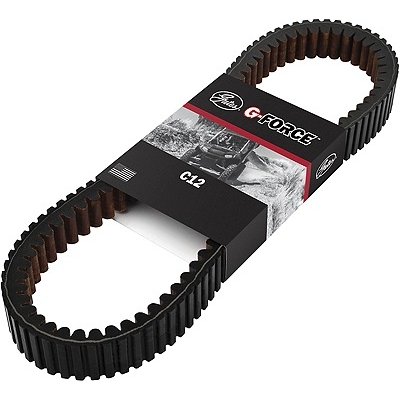


Gates G-Force C12 Drive Belt for Can-Am Traxter 650 ATV

Gates G-Force C12 Drive Belt for Can-Am Traxter 650 ATV
$155.99
Sale price
$155.99
Regular price
$155.99
SKU:1004-3285
My Garage
Select a ride to guarantee fitment.
My Garage
Add your vehicles to your garage. Several features will then be available to facilitate your searches.
- Store vehicles in your garage
- Easily find guaranteed fit products and accessories
- Get product recommendations
Available Online
Free shipping on orders over $99
Standard Fulfillment: -
Expedited Fulfillment: -

Lowest Price Guaranteed

Fast Shipping

Easy Returns
Description
For over a century, Gates has driven innovation in belt technology to power the machines that move you. Gates® G-Force C12 CVT belt drives are engineered to navigate the toughest off-road trails with power and efficiency. The industry's first CVT belt with carbon tensile cord also features a trapezoid top-notch and rounded cog design for superior flexibility and heat dissipation, along with a unique gum adhesion that reduces fiber pullout within the belt extending the life of the belt. Gates combines material science and process engineering to create innovative products that provide performance, reliability and the strength to withstand even the most challenging off-road environments. Continuous innovation isn't just what we do. It's who we are.
WHY G-FORCE C12 BELTS?
- STRENGTH: The first CVT belt utilizing carbon tensile cord for minimal stretch and extraordinary strength.
- FLEXIBILITY: High-performance neoprene with a trapezoidal topnotch and rounded bottom cog design maximizing heat control and flexibility.
- DURABILITY: Carbon tensile cords are bonded to aramid fiber-loaded rubber with specially formulated adhesion gum, resulting in increased side-load resistance, preventing belt distortion and edge cord pullout.
- PERFORMANCE: Gain optimal power transmission for faster acceleration, improved throttle response and consistent shifting performance.
Features
- Advanced carbon cord results in minimal stretch with extraordinary strength for faster acceleration.
- Trapezoidal top cog with rounded bottom cog provides excellent flexibility and efficiency.
- Aramid fiber loaded elastomer compound for durability and optimized performance.
- Gains optimal power transmission for fast acceleration, improved throttle response and consistent shifting performance.
- Maintains peak power throughout the shift curve.
Technical Specifications
- MFG. Part Number 43C4533
Vehicle Information
Can-Am Traxter 650 ATV (2005)
The 2005 Can-Am Traxter 650, branded as Bombardier at the time, was a robust ATV featuring a powerful engine and several trim options. It was equipped with a liquid-cooled, 4-stroke, single-cylinder, 4-valve SOHC engine with a displacement of 644 cm³ (644cc), producing 35 lb-ft of torque at 3000 RPM. The 2005 model year brought a significant repositioning, integrating the Quest model line into the Traxter family and rebranding it as the Traxter Automatic CVT. The 2005 Traxter 650 models primarily featured a heavy-duty 6-arm CVT fully automatic transmission. The 4-TEC Rotax engines were optimized for maximum torque at low and medium RPM. A major innovation was the introduction of the MAX series, the first ATVs specifically engineered for two riders, available in standard and XT versions with additional accessories. Q: Is this product compatible with my 2005 Can-Am Traxter 650?
R: To ensure perfect compatibility, please use our year and model selector at the top of the page.
Maintenance
| Component | Interval | Details |
| Engine Oil & Filter | Annually, or every 3,200 km or 200 hours | For severe use, halve the interval (1,600 km or 100 hours). |
| Drive Belt | Inspect every 1,600 km or 50 to 100 hours. Replace every 3,200 km or 100 hours. | Replace sooner if signs of damage (cracks, fraying) are observed. |
| Spark Plug | Every 2 years, or every 6,400 km or 400 hours | Some guides suggest replacement every 100 hours for optimal performance. |
| Air Filter | Inspect every 25 to 50 hours or after every ride in dusty/muddy conditions. Replace annually, or every 3,200 km or 200 hours. | Replace if damaged, dirty after cleaning, or if engine performance does not improve. |
| Coolant | Every 5 years or 12,800 km | Check levels before every ride. Some guides suggest replacement every 2 years or 200 hours. |
Maintenance intervals are based on general Can-Am ATV guidelines. For precise and official information, please consult the owner's manual for your 2005 Can-Am Traxter 650.